
Homewood Directory Runs by Year
Homewood usually appears within Birmingham or Birmingham-suburban titles. The main publisher family is R. L. Polk & Co., whose mature volumes may include alphabetical residents, businesses, a street guide, and a classified section. The safest starting point is an edition that names Homewood explicitly. Broader Birmingham reels can still help, but a catalog title alone does not prove that every predecessor community appears inside.
| Collection | Years represented | Where held | How to use it |
|---|---|---|---|
| Birmingham city directory, Homewood named | 1941, 1942 | Birmingham Public Library Southern History | Reference collection by appointment |
| Birmingham city directory, Homewood named | 1949-60, with listed gaps and combined editions | BPL and indexed microfilm runs | Check the exact edition before citing |
| Birmingham Suburban directory | 1974, 1980, 1988, 1989, 1990 | Directory microfilm sequence | Homewood is explicit |
| Broader Birmingham directories | 1888-1992, with gaps | BPL Southern History and microfilm index | Verify community coverage edition by edition |
| Birmingham telephone directories | 1926-27 and 1928-30 | Library of Congress digital collection | Homewood entries are included |
No authoritative source supplies a complete post-1960 Homewood shelf list or a definite last Polk publication year. The research also found no complete, separately titled criss-cross run. Those gaps make edition-level notes essential. Record the title, year, repository, and page viewed, not just a copied name.
Why Homewood Directories Say Birmingham
Homewood's municipal history traces growth from several communities. Edgewood, Rosedale, and Grove Park combined in 1926, Hollywood joined in 1929, and Oak Grove followed in 1955. A Homewood city directory search before those dates should test each earlier place name. Older census schedules may use a county precinct, while publishers may group the same household with Birmingham-area coverage.
The larger Birmingham sequence begins well before Homewood incorporation. Years indexed include runs from the late 1880s through 1940, then later reels in 1971, 1973, 1975, 1978, 1980, 1983, 1985, 1987, 1988, 1990, 1991, and 1992. This is an author index, not proof of Homewood content in every reel. Search geography independently when the city is absent from the title.
That distinction prevents a false negative. A resident missing under “Homewood” may still appear under Rosedale, Edgewood, Grove Park, Hollywood, Oak Grove, a precinct number, or a Birmingham-suburban heading.
Homewood City Directory Shelf Access
The Birmingham Public Library Southern History Department holds the core Birmingham directory collection beginning in 1883. It is on the first floor of the Linn-Henley Research Library at 2100 Park Place. The department is appointment-only Monday through Friday, 9:00 a.m. to 6:00 p.m. Materials are reference-only and cannot circulate or travel by interlibrary loan.
The library offers a useful remote option when the request is narrow. Give staff a name, one edition or year, and an address if known. A specific-copy response is normally made within 48 hours. The research fee is $5; an emailed PDF is the least costly stated delivery method. Mailed copies cost $0.30 per page plus postage, with a 20-page limit and prepayment. Staff can suggest search tactics but does not conduct a full family history.
The official Southern History page shows the practical entry point to these Homewood city directories.
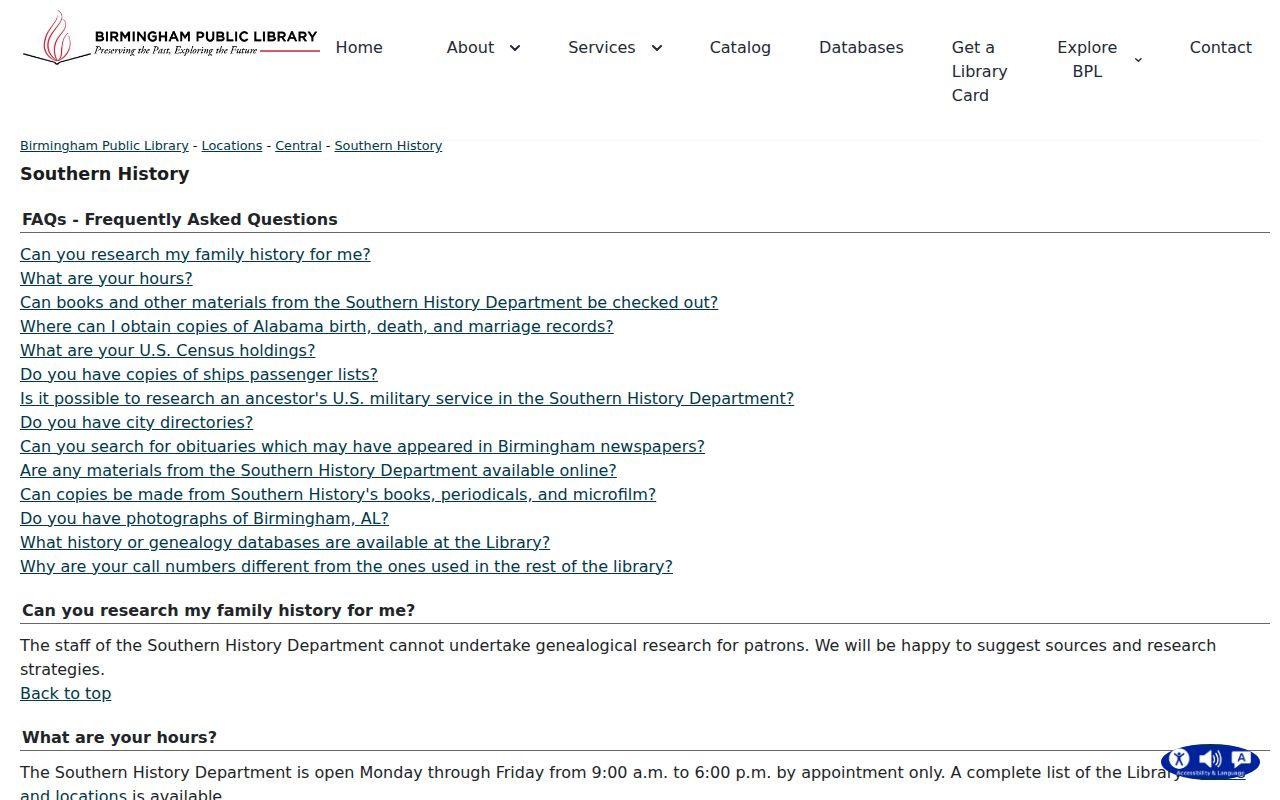
The collection screen is the place to confirm appointment rules and request terms before asking for a particular volume.
Note: A 48-hour response applies to focused copy requests, not an open-ended search across many surnames and years.
Homewood Directory Clues Online
The ADAH-hosted Homewood digital collection adds community studies, local images, and records supplied through Homewood Public Library. It does not replace the full directory shelf. Its strength is context: a street, church, school, or neighborhood clue can explain why a name appears differently in a printed edition.
Homewood Public Library, at 1721 Oxmoor Road, also provides in-building Ancestry and Jefferson County Library Cooperative databases. Its local bibliography identifies bound Edgewood, Hollywood, and Homewood council minutes, vertical clipping files, Rosedale studies, local histories, and an Early Homewood video. The official pages do not list exact city directory years, so use BPL for the documented run and the Homewood library for local context and staff guidance.
The state archive interface offers a visual route into Homewood's digitized history. A digital item can supply a variant street or community name to carry back to the printed city directories.
When the digital collection stops short, the Alabama Department of Archives and History research room and County Records on Microfilm catalog provide another access channel. ADAH also accepts one-surname paid research requests covering no more than four sources. The documented fee is $15 for an Alabama resident and $25 for an out-of-state requester, including up to 20 pages, with added pages at $0.25 each. The stated turnaround is two to three weeks. A focused Homewood name, date range, and former community label gives staff a workable request.
Read a Homewood Directory Entry
An entry is a dated publisher snapshot. The official Rosedale study shows that “Rev. Mitchell” Jerald and wife Emma appeared at 1708 25th Terrace South in 1953. His workplace was American Brake Shoe Wheel. By 1960, the listing described him as a Baptist minister at the same address, while church and classified evidence connected him with Mt. Avery Oak Grove Baptist. Adult children appeared with their own work and address details.
| Printed identity | Surname, given name, honorific, and any spouse text exactly as set |
|---|---|
| Home line | Street number and street name as printed in that edition |
| Work line | Occupation, employer, or a business cross-reference when supplied |
| Household clues | Spouse and separately listed adult children, without assuming an unlisted relationship |
| Edition marks | Symbols and abbreviations interpreted only through that volume's key |
The source does not reproduce a full publisher page or prove property-status symbols. Do not import marks from another edition. Transcribe what is visible, then photograph or note the key from the same volume.
- Criss-cross directory
- A directory arranged by street address or telephone number rather than only by surname. No complete Homewood run was verified.
- Householder index
- A section that may place listed householders in civic-number order. Its presence must be checked in each edition.
- Abbreviation key
- The edition's own list explaining shortened occupations, titles, and other marks.
Trace Homewood Families by Directory
A good Homewood city directory trail preserves uncertainty. “Not listed” is not the same as “not living there.” A missing edition, an unlisted household, a changed surname, incomplete publisher coverage, or a move into the business section can all cause a gap. Build a year-by-year grid before drawing conclusions.
- Start with one known year and search the surname, spelling variants, initials, and honorifics.
- Copy the spouse text, exact address, occupation, employer, cross-references, and every abbreviation.
- Bracket a missing year with the prior and next available editions, then test a street or householder section if that edition has one.
- Pair the trail with the 1930, 1940, or 1950 census, using the address and workplace to separate people with the same name.
- Use an obituary for relatives and Probate for official estate roles when the directory trail ends.
The public census line ends at 1950 under the 72-year rule. Directory boundaries and census enumeration boundaries were created for different purposes, so a disagreement can reflect geography rather than a change in the household.
Street Changes in Homewood Directories
Street names can create the appearance of a move. In Rosedale, Park Avenue became Montgomery Highway and later 18th Street South. Tenth Street became 26th Avenue South. A search that uses only the modern label may miss the same household in an older Homewood city directory.
Retain the old address exactly as printed. Then compare the directory with a plat, legal description, census enumeration, or historic map. Homewood's municipal history also matters: pre-1926 records may use Rosedale, Edgewood, Grove Park, or a county precinct; Hollywood needs pre-1929 searches, and Oak Grove needs pre-1955 county labels.
Note: No authoritative citywide street-renaming concordance was found, so these verified Rosedale examples should not be treated as a universal formula.
Pair Homewood Directories With Records
Directories work best beside sources that answer a different question. BPL holds Alabama census microfilm through 1930 and offers in-library access to later census partners. Its newspaper runs include the Birmingham News, Post-Herald, Age-Herald, Birmingham World, and Birmingham Times. The library also maintains an obituary index.
Use the directory's occupation, employer, spouse, and street as search keys in newspapers. A death, marriage, church appointment, school event, or business opening can separate two people with the same name. An obituary can identify relatives, but it does not prove a current address. Probate records establish estate roles and may show filing-time addresses.
Samford adds another dated spine. Its Special Collection holds physical Entre Nous yearbooks from 1909 and digitized volumes from 1912 through 2025 with gaps, plus the Howard Crimson from 1915 and Samford Crimson from 1966. Howard College moved to Homewood in 1957, so earlier university entries do not by themselves place a person in Homewood.
Homewood History Beyond Directories
The Jefferson County Historical Society catalog spans manuscripts, maps, letters, and ledgers from the 1800s to the present. Samford Special Collection holds Alabama Baptist association records, denominational newspapers, church materials, oral histories, and university archives. These collections can confirm an institution or place mentioned in a city directory without turning that affiliation into a present address.
The Historical Society search screen is a second shelf for context after a directory yields a name, organization, or map clue.
Search results should be cited by collection and item. A catalog match shows that a record exists; the item itself must support the family-history claim.
For a modern address-keyed search, use the Homewood street directory workflow. Historical volumes answer who was printed at a place in a given year, not who occupies it now.